Healthcare Association Moves Apex Court Seeking Exclusion of Medical Services
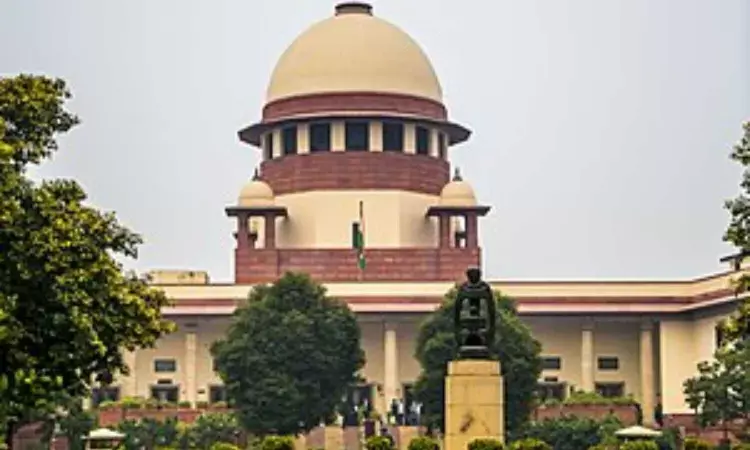
The Supreme Court of India on Wednesday issued notices to the Union Government and the National Medical Commission (NMC) on a plea seeking exclusion of doctors and healthcare service providers from the purview of the Consumer Protection Act (CPA), 2019. The matter has once again brought into focus the long-standing debate over whether medical services should be treated as “services” under consumer law.
The petition has been filed by the Association of Healthcare Providers (India), which has sought directions to the Centre and the NMC to declare that services rendered by healthcare professionals are not covered under the Consumer Protection Act, 2019. The association has also requested that consumer forums across the country be directed not to entertain complaints against healthcare providers under the Act.
A three-judge bench comprising Chief Justice of India Surya Kant, Justice Joymalya Bagchi, and Justice N.V. Anjaria has taken up the matter and sought responses from the Centre and the apex medical regulator. As of now, there is no change in the legal position, and doctors continue to fall within the ambit of the Consumer Protection Act.
The current legal position stems from the landmark 1995 judgment in Indian Medical Association vs. V.P. Shantha & Others. In that ruling, a three-judge bench of the Supreme Court held that medical services, including consultation, diagnosis, and treatment—both medicinal and surgical—would fall within the definition of “service” under Section 2(1)(o) of the Act, except where services are rendered free of charge to every patient or under a contract of personal service.
Section 2(1)(o) of the Consumer Protection Act defines “service” as service of any description made available to potential users, including facilities related to banking, insurance, transport, housing construction, entertainment, and more. However, it excludes services rendered free of charge or under a contract of personal service. The 1995 verdict interpreted this definition broadly to include medical practitioners.
The issue was revisited in May 2024 when a two-judge bench referred the 1995 judgment to a larger bench, observing that the matter required reconsideration. However, a subsequent three-judge bench declined to reopen the ruling, holding that such reconsideration was not necessary and maintaining the existing legal framework.
In the latest plea, the Association of Healthcare Providers (India) has argued that equating medical practice with commercial transactions overlooks the unique and uncertain nature of healthcare delivery. The petition contends that medical professionals exercise expert judgment in complex and unpredictable situations, and their services cannot be assessed on the basis of assured outcomes, unlike other consumer services.
The association has also relied on a Supreme Court ruling that excluded advocates from the scope of the Consumer Protection Act, arguing that similar reasoning should apply to doctors. It further claimed that the increasing number of consumer complaints has led to defensive medical practices, with doctors allegedly becoming hesitant to take necessary risks, particularly in emergency cases. Additionally, the petitioners argued that consumer forums may not be adequately equipped to handle intricate medical issues and pointed out that doctors are already regulated by the NMC, which has mechanisms to address professional misconduct and negligence.