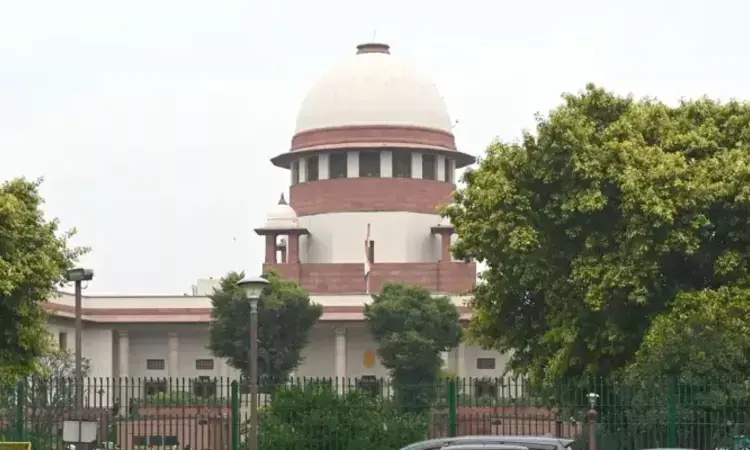
The Supreme Court of India has granted relief to a paediatric surgeon by quashing criminal proceedings related to an orchidectomy performed on a toddler, ruling that the procedure was medically justified and no malice could be attributed to the doctor.
Court Finds No Malice, Procedure Medically Recognised
A Division Bench comprising Justices PS Narasimha and Manoj Misra observed that orchidectomy is a recognised alternative procedure in cases of undescended testicles, especially to prevent future malignancy.
The Bench noted that expert opinion from a Medical Board supported the doctor’s decision, stating that the surgery adopted was appropriate under the circumstances.
Dispute Centered Around Consent
The case revolved around allegations by the child’s father, who claimed he had consented only to an orchidopexy procedure and not to orchidectomy. He further alleged that the consent form had been manipulated after the surgery to falsely indicate approval for testicle removal.
However, the Court found that a consent form had indeed been signed prior to surgery, and it clearly mentioned both procedures—orchidopexy and orchidectomy—separated by a slash, indicating alternative options.
No Evidence of Tampering in Consent Form
The Court highlighted that the consent form had been examined by the Director of Medical and Rural Health Services, who found no irregularities. Additionally, there was no forensic evidence suggesting interpolation in ink or handwriting.
While acknowledging that disputes over document tampering are generally matters for trial, the Court clarified that in exceptional cases, such issues can be examined under Section 482 CrPC to prevent abuse of legal process.
Medical Opinion Supports Surgeon’s Decision
The Medical Board concluded that orchidectomy is a standard alternative in such medical situations and may be necessary to mitigate the risk of future cancer.
The Court emphasised that the operating surgeon is best placed to decide the appropriate course of treatment during surgery, particularly in emergent medical scenarios.
Apex Court Terms Proceedings ‘Abuse of Process’
Taking into account the absence of malice, existence of a valid consent form, and supporting medical opinion, the Court held that continuing criminal proceedings would amount to an abuse of the judicial process.
Accordingly, it quashed the case, overturning the earlier decision of the Madras High Court, which had refused to do so and instead directed an expedited trial.
Background of the Case
The case originated from an FIR registered in 2006 under multiple provisions of the Indian Penal Code, including charges of forgery, criminal conspiracy, and causing hurt.
Despite medical reports supporting the surgeon, the trial had continued for years, prompting the doctor to seek relief from the apex court after the High Court declined to quash the proceedings.
Key Takeaway
The ruling underscores that when medical procedures are backed by expert opinion and documented consent, criminal prosecution against doctors may not be sustainable—especially in the absence of malafide intent or concrete evidence of wrongdoing.