NEW DELHI — In a major development that could reshape the landscape of medical education in India, the Indian Medical Association (IMA) has formally written to Union Education Minister Dharmendra Pradhan demanding a radical overhaul of the National Eligibility cum Entrance Test (Undergraduate). Following the absolute cancellation of the medical entrance examination amid widespread allegations of a large-scale question paper leak, the nation’s apex body of doctors has explicitly called for the decentralisation of the entire examination system. The association argued that the current single-day, offline format has proven to be entirely unworkable and prone to structural systemic failure.
The dynamic push for structural reform comes at a time when the credibility of the National Testing Agency (NTA), the central regulatory body responsible for conducting high-stakes national assessments, is facing severe scrutiny. In its official correspondence, the medical body presented a comprehensive list of nine distinct demands aimed at restoring public trust, safeguarding student merit, and ensuring strict legal accountability for perpetrators involved in the exam malpractice.
The primary recommendation put forward by the doctors’ association involves transferring a substantial portion of testing responsibilities directly to the individual states and Union Territories. The association proposed that these localized administrations operate under a highly transparent, unified, and accountable central framework. By shifting the logistical burden away from a single centralized agency, the association believes regional oversight will drastically minimize vulnerability windows and effectively prevent coordinated, pan-India question leaks. This proposal aligns closely with growing regional political sentiments, following several public appeals by state leaders to grant independent control over filling localized medical seats.
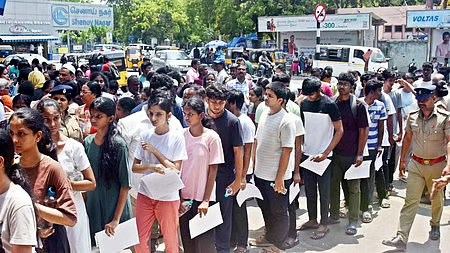
Highlighting the sheer magnitude of the crisis, the medical association noted that more than 22.5 lakh hardworking aspirants sat for the examination across 5,500 test centres situated in over 551 cities nationwide. The recurring controversies and administrative irregularities—marking multiple significant disruptions within the past four years alone—have inflicted immense mental trauma, emotional distress, and financial hardship upon millions of families who dedicate years of intense sacrifice and discipline toward securing medical admissions.
To combat future security breaches, the medical body has advocated for an immediate transition from traditional OMR physical sheet test sheets to advanced computer-based tests (CBT) across all testing territories. Implementing an encrypted online delivery system is viewed as a crucial technological safeguard to completely eliminate the physical transportation risks of paper documents. In response to the growing national outcry, the Union Education Ministry has already signaled alignment on this front, announcing that subsequent iterations of the pre-medical entrance will leverage computerized testing methodologies to maintain the absolute sanctity of the selection process.
Beyond immediate technological shifts, the association’s demands call for stringent criminal and legal retribution. The medical body has urged for a time-bound, impartial investigation conducted by the Central Bureau of Investigation (CBI) to trace the entirety of the illicit network and identify every single compromised individual and institution. Furthermore, the correspondence strongly advises the central government to establish specialized fast-track courts for daily judicial hearings. This mechanism is designed to guarantee swift, exemplary punishment under specialized laws relating to examination malpractices, sending an unequivocal message to criminal syndicates targeting national merit systems.
The medical association concluded its appeal by stressing that the healthcare profession is inherently built upon foundational pillars of ethics, credibility, and trust. Consequently, the mechanism used to select the next generation of physicians must reflect those exact values. As the government prepares for a rescheduled examination phase, the medical community continues to emphasize that providing accessible psychological counselling platforms and transparent re-examination timelines remains non-negotiable to protect the structural integrity of India’s healthcare future.
The demand for decentralisation also touches upon the logistical impracticality of managing a single-day event for millions of students. According to the medical body, the concentration of power and information in a single entity creates a “single point of failure.” By distributing the responsibility, the risks are mitigated, and local authorities can be held more directly accountable for the sanctity of the process within their jurisdictions. This move is seen as essential not just for security, but for the administrative efficiency required to handle the growing number of medical aspirants in the country.
As this debate continues to unfold, the focus remains on the millions of students whose careers hang in the balance. The implementation of these proposed reforms would mark one of the most significant shifts in Indian educational policy in decades, potentially ending the era of centralized, high-stakes testing in favor of a more resilient, distributed model.