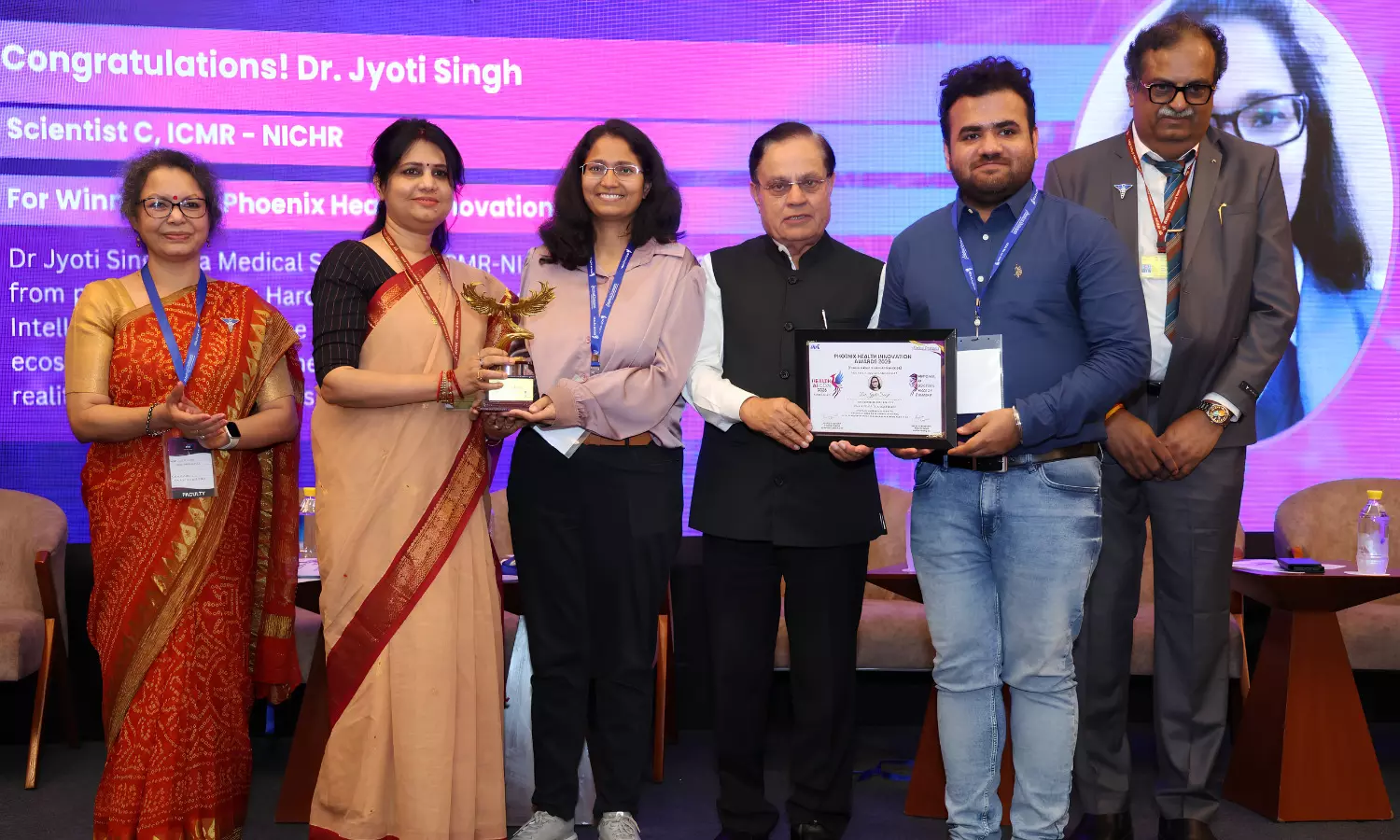
ICMR Scientist Honoured for Developing AI Platforms EviFlow and EviXtract to Accelerate Evidence-Based Medical Research
New Delhi: Scientist Dr Jyoti Singh was honoured with the prestigious Phoenix Award at HealthAIcon 2026 for her contribution to AI-driven healthcare research and evidence-based medical innovation.
The award was presented by Dr Abhijat Sheth, Chairperson of the National Medical Commission (NMC) and President of NBEMS, along with Dr Anil Kohli, Former President of the Dental Council of India, and Dr Sanghamitra Pati, Additional Director General, ICMR, during the event held at Hotel Eros, New Delhi, on May 17, 2026.
Currently serving as a Medical Scientist at ICMR-NICHR, Dr Jyoti Singh has nearly 14 years of experience in medical research and works in the field of artificial intelligence, evidence synthesis, and healthcare research automation.
AI Platforms Developed to Simplify Systematic Reviews
Dr Singh has developed two AI-powered platforms — EviFlow and EviXtract — aimed at reducing the time researchers spend on literature reviews, identifying research gaps, and evidence synthesis.
EviFlow scans scientific literature from PubMed, analyses inconsistencies and evidence gaps, and generates structured research questions for future studies.
Her second innovation, EviXtract, is an AI-assisted data extraction platform capable of processing research papers, including scanned PDFs, and automatically extracting qualitative and quantitative data into structured formats with confidence scoring and evidence tracking.
Systematic reviews are considered one of the highest forms of scientific evidence in medicine, but they are often highly time-consuming and resource-intensive. Dr Singh’s innovations aim to make evidence synthesis faster, more transparent, and more accessible, especially for researchers working in resource-limited settings.
‘Human-in-the-Loop’ AI Model Ensures Scientific Oversight
A key aspect of both platforms is the “human-in-the-loop AI” approach, where artificial intelligence supports researchers without replacing scientific oversight or clinical judgment.
Speaking exclusively to Health Dialogues Managing Editor Deshbandhu Singh, Dr Jyoti Singh said the idea behind EviFlow emerged from the challenges faced while manually reviewing literature and identifying relevant research gaps.
“Whenever I searched for a new research topic, I spent months reviewing literature and trying to identify the research gap. I always wondered whether this process could be simplified and made more systematic,” she said.
She further explained that EviXtract was developed after researchers had to manually analyse nearly 300 papers during systematic reviews, making data extraction an extremely lengthy process.
AI Can Reduce Months of Research Work to Weeks
According to Dr Singh, EviFlow can reduce months of literature review and research-gap identification work to just minutes for a specific query.
She added that EviXtract has the potential to shorten the data extraction stage of systematic reviews from 9–12 months to only a few weeks.
Explaining how EviFlow works, Dr Singh said the platform converts user queries into MeSH (Medical Subject Headings) terms and systematically searches PubMed.
The platform then analyses published studies for gaps related to methodology, geography, population groups, quality of evidence, and conflicting findings before generating structured research questions using the PICO format.
EviXtract Designed for Transparent and Reliable AI-Assisted Research
Highlighting the difference between EviXtract and existing global AI tools, Dr Singh said many AI systems still require extensive manual work and often lack transparency.
“EviXtract generates validated multi-sheet Excel outputs with verbatim source citations, reasoning statements, and confidence scores,” she said.
The platform also flags doubtful outputs for manual verification, helping maintain transparency and scientific reliability.
Dr Singh noted that EviFlow uses authentic PubMed and MeSH-based search strategies to avoid hallucinations and false citations, while EviXtract verifies and corrects its own outputs wherever possible.
AI to Assist Researchers, Not Replace Scientific Judgment
Dr Singh emphasised that the objective of these platforms is not to replace researchers but to assist them by reducing repetitive manual tasks.
“The idea is to use AI as an assistant, not as a replacement for scientific judgment,” she said.
She added that such platforms could play a major role during future pandemics and public health emergencies by significantly reducing the time required for literature review, evidence generation, and research planning.
Addressing concerns around AI reducing scientific rigour, Dr Singh said scientific integrity depends on how responsibly technology is used.
Funding and Multidisciplinary Collaboration Remain Major Challenges
Speaking about the challenges faced while developing the innovations, Dr Singh said finding people willing to work beyond traditional research boundaries and collaborate across disciplines was one of the biggest hurdles.
She also highlighted funding limitations, noting that most research support systems continue to focus mainly on conventional research areas.
Looking ahead, Dr Singh said the future goal is to integrate multiple research databases and build an end-to-end AI-assisted research ecosystem that can support researchers from literature review to data analysis and publishing.
“The idea is not to reduce scientific rigour, but to free researchers from repetitive manual tasks so they can focus more on scientific thinking and decision-making,” she said.