

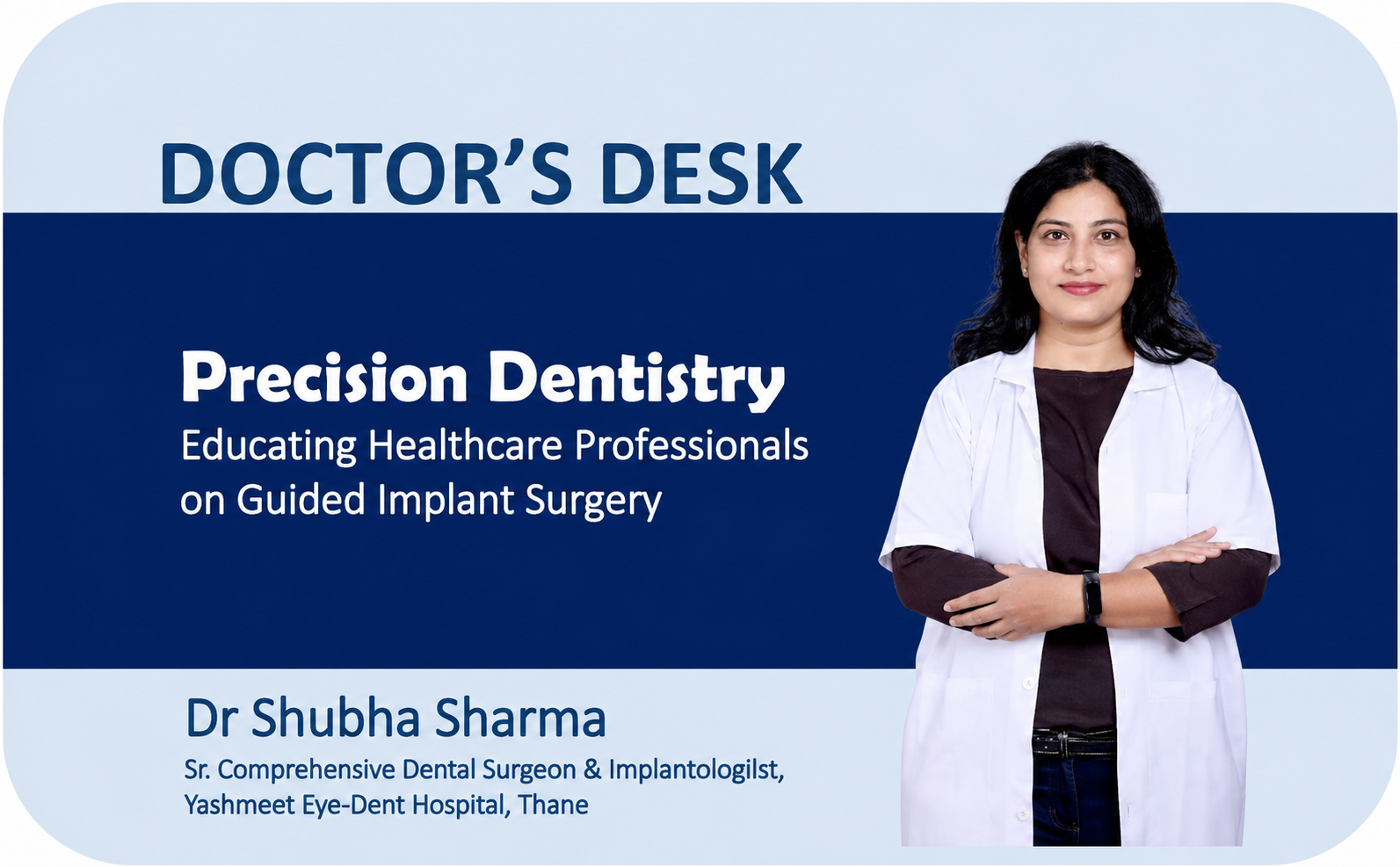
As healthcare providers, our shared goal is optimizing patient outcomes through evidence-based interventions. While dental implants remain the gold standard for tooth replacement, the methodology behind their placement has undergone a digital revolution. For general practitioners (GPs) and broader healthcare professionals, understanding Guided Implant Surgery is a baseline requirement for comprehensive patient education and holistic treatment planning. This article provides an overview of guided implant technology, detailing clinical indications, advantages, and limitations.
What is Guided Implant Surgery?
Guided implant surgery is a digitally driven workflow that transitions implant dentistry from a reactive procedure to a proactive, restoratively driven science. The process fuses two distinct data sets:
- Cone Beam Computed Tomography (CBCT): Provides a high-resolution, 3D radiographic view of hard tissue, bone density, and vital anatomical structures.
- Intraoral Digital Scans: Captures precise surface topography of the dentition and surrounding soft tissues.
Specialized software overlays these data sets, allowing clinicians to virtually plan the exact position, depth, angulation, and diameter of the implant before surgery. This virtual plan is translated into the physical operatory via a 3D-printed static surgical guide, which mechanically restricts surgical drills to the pre-planned pathways.
Identifying the Clinical Need: When is Guided Surgery Essential?
GPs and medical professionals are uniquely positioned to identify patients who require the safety margins of a guided approach. While freehand surgery remains viable in straightforward cases, guided surgery is the clinical standard in the following scenarios:
- Proximity to Vital Anatomy: Cases bordering critical structures like the inferior alveolar nerve, mental foramen, or maxillary sinus floor.
- Compromised Bone Volume: Patients with severe alveolar atrophy where the margin for error is minimal.
- Full-Arch Rehabilitation: Multi-implant cases (e.g., All-on-X) requiring parallel placement to prevent catastrophic prosthetic failure.
- High Aesthetic Vulnerability: Anterior single-tooth replacements where labial bone thickness dictates visual outcomes.
- Medical Comorbidities: Patients with controlled conditions or anxiety who benefit from reduced surgical time and less invasive protocols.
Clinical Advantages: The Triad of Predictability
Embracing guided surgery offers measurable benefits that impact patient health and procedural longevity:
- Superior Anatomical Safety: Visualizing vital structures in three dimensions drastically reduces the risk of nerve paraesthesia, sinus perforation, or root damage.
- Restoratively Driven Positioning: The ideal final tooth position is designed digitally first, and the implant is planned to support that specific restoration, ensuring optimal biomechanical force distribution.
- Minimally Invasive Preservation: Precise guides often allow for flapless techniques, preserving peri-implant blood supply, reducing post-operative swelling, and accelerating healing.
Drawbacks and Limitations: A Balanced Perspective
To maintain objective clinical judgment, practitioners must understand the limitations of guided technology:
- Increased Timelines and Costs: Shifting time to the pre-surgical planning phase requires lead time for guide fabrication and introduces higher upfront diagnostic costs.
- Anatomical and Spatial Restrictions: Surgical guides and drill assemblies are bulky. Patients with limited mouth opening or severe trismus in posterior regions may lack sufficient inter-occlusal clearance.
Conclusion
Guided implant surgery represents a paradigm shift from traditional tactile feedback to data-driven precision. By understanding its mechanics, indications, and limitations, general practitioners can better educate patients, demystify advanced procedures, and elevate standards of interdisciplinary care.

Dr Shubha Sharma
Sr. Comprehensive Dental Surgeon & Implantologilst,
Yashmeet Eye-Dent Hospital, Thane

