

1,706 Clinical Cardio-Physicians to Strengthen Rural Healthcare as India Faces Rising Heart Disease Burden
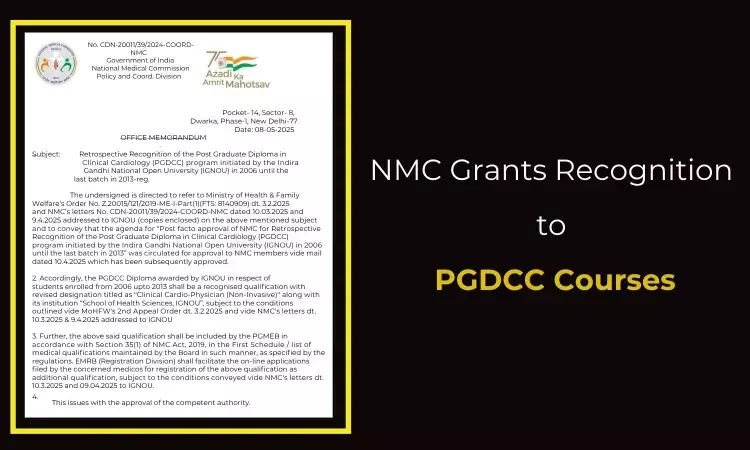
In a landmark move, the National Medical Commission (NMC) has officially granted retrospective recognition to the Post Graduate Diploma in Clinical Cardiology (PGDCC) course conducted by Indira Gandhi National Open University, bringing closure to a two-decade-long legal and regulatory struggle.
The decision recognizes PGDCC qualifications for students enrolled between 2006 and 2013, redesignating them as “Clinical Cardio-Physician (Non-Invasive)”. This development is expected to significantly boost India’s cardiology workforce, particularly in underserved rural and semi-urban regions.
Recognition Approved After Years of Legal Disputes
The PGDCC programme, launched in 2006, aimed to create a cadre of non-invasive cardiology specialists through a two-year structured training program for MBBS graduates. However, the course faced continuous resistance from the erstwhile Medical Council of India (MCI), which refused recognition citing regulatory violations.
Despite multiple appeals and court interventions, including proceedings in the Delhi High Court, the course remained unrecognized for years. The issue persisted even after the NMC replaced the MCI—until now.
An Office Memorandum issued on May 8, 2025, following approval from the Ministry of Health and Family Welfare, confirmed retrospective recognition of the course. The qualification will now be included in the official list of recognized medical qualifications under the NMC Act, 2019.
1,706 Doctors Join Mainstream Healthcare System
With the recognition now formalized, 1,706 trained clinical cardiologists have successfully registered their additional qualification in the Indian Medical Register after verification by the NMC.
According to the Indian Association of Clinical Cardiologists, this step will allow these professionals to be integrated into the public healthcare system, including eligibility for government recruitment.
Dr. Rajesh Rajan, Chairman of IACC’s Board of Governors, confirmed that doctors recently received their final registration certificates after a detailed verification process involving MBBS credentials, university degrees, and state medical council clearances.
Major Boost for Rural Cardiology Services
Healthcare experts believe the decision could be transformative for India’s rural healthcare infrastructure.
India currently faces a severe shortage of cardiologists, with only 5,000–6,000 specialists serving over 1.4 billion people. This translates to roughly one cardiologist per 2–3 lakh individuals—far below global standards.
Cardiovascular diseases account for nearly 28% of all deaths in India, with cases rising तेजी से in Tier-2 and Tier-3 cities. The newly recognized PGDCC doctors are expected to help bridge this critical gap.
Experts suggest that deploying even 2–3 such specialists per district could significantly improve early diagnosis and management of heart diseases in rural areas.
Policy Shift Seen as ‘Game Changer’
The recognition is being hailed as a bold policy shift that could reshape India’s approach to specialist training and healthcare delivery.
Senior medical educators, including Prof. A. K. Agarwal, noted that the programme had already trained doctors across 77 institutions nationwide under expert supervision. With formal recognition, these professionals can now contribute fully to structured healthcare services.
The decision has also reignited discussions on restarting similar programs to address the growing shortage of specialists and curb the spread of unqualified practitioners in rural India.
Government Credited for Final Decision
The IACC has credited Prime Minister Narendra Modi and Union Health Minister J. P. Nadda for resolving the long-pending issue.
After years of inaction by successive administrations, the final approval is being viewed as a decisive intervention that prioritizes healthcare accessibility and workforce expansion.
What It Means for India’s Healthcare Future
The NMC’s decision not only legitimizes thousands of trained professionals but also signals a broader shift toward capacity-building in India’s healthcare system.
With rising lifestyle diseases, early-onset cardiac conditions, and increasing demand for specialized care, integrating mid-level specialists like Clinical Cardio-Physicians could play a crucial role in strengthening the country’s medical infrastructure—especially where it is needed the most.
