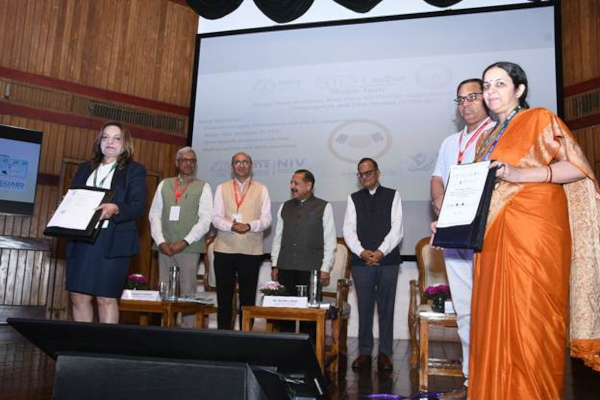
NEW DELHI: Marking a significant milestone in India’s quest for a self-reliant healthcare infrastructure, the Indian Council of Medical Research (ICMR) successfully executed the commercial transfer of three highly impactful, indigenously developed medical technologies to private industry partners. The landmark licensing agreements were formalized at the high-profile “Vigyan-Tech 2026” national programme, organized to celebrate National Technology Day 2026 at the BRIC–National Institute of Immunology (NII) campus. Facilitated under the apex research body’s signature Medical Innovations Patent Mitra initiative, these technology transfers underscore a strategic “whole-of-government” push to convert laboratory breakthroughs into scalable, accessible, and affordable diagnostic solutions for the masses.
The high-profile event was attended by Union Minister of State (Independent Charge) for Science and Technology Dr. Jitendra Singh, Principal Scientific Adviser to the Government of India Prof. Ajay Kumar Sood, and Dr. Rajiv Bahl, Secretary of the Department of Health Research and Director General of ICMR. The platform brought together 14 scientific ministries and autonomous laboratories, highlighting an integrated state initiative to fast-track commercial licensing and accelerate local manufacturing.
The three transferred technologies address critical, long-standing gaps in urology, hematology, and infectious disease management:
- PSP94 ELISA Kit for Prostate Cancer Screening: The first commercialized technology is a highly cost-effective PSP94 ELISA kit designed to guide critical prostate biopsy decisions in patients exhibiting Prostate-Specific Antigen (PSA) levels of less than 20 ng/ml. Developed by a specialized research team comprising Dr. Dhanashree Jagtap, Dr. Smita Mahale, and Dr. Bhakti Pathak at the ICMR–National Institute for Research in Reproductive and Child Health (formerly NIRWoH), this diagnostic innovation will prevent unnecessary, invasive biopsies for thousands of male patients. The global commercial production rights for this technology were licensed directly to Krishgen Labs Pvt. Ltd.
- Factor VIII Inhibitor Point-of-Care Diagnostic: The second innovation targets severe coagulation disorders, featuring a Factor VIII Inhibitor/Coagulation Disorder Point-of-Care Diagnostic. Formulated by Dr. Rucha Patil at the ICMR–National Institute for Research on Blood and Immune Disorders (ICMR-NIRBID), this point-of-care tool allows clinicians to instantly diagnose bleeding disorders at the bedside, saving valuable turnaround time in emergency trauma scenarios. The technology was officially licensed to global medical device major Meril Life Sciences.
- Single-Tube Multiplex Real-Time RT-PCR Assay: The final technology addresses vector-borne outbreaks via a Single-Tube Multiplex Real-Time RT-PCR assay that can simultaneously detect the presence of Dengue, Chikungunya, and Zika viruses from a single patient sample. Developed by Dr. Alagarasu K at the ICMR–National Institute of Virology (ICMR-NIV) in Pune, this high-throughput kit streamlines epidemiological surveillance during heavy monsoon periods. The technology was successfully licensed to Vanguard Life Sciences for large-scale industrial manufacturing.
Alongside these three landmark industry transfers, the research council also released a comprehensive national compendium showcasing 25 promising upcoming innovations born across various regional ICMR institutes. The featured pipeline ranges from digital health surveillance applications to niche medical devices and disease-tracking software. Additionally, an exclusive exhibition segment displayed six previously successful, high-impact indigenous medical solutions, including Covaxin, the specialized COVID Kavach ELISA Kit, a cutting-edge CRISPR-Cas-based Tuberculosis detection framework, a rapid point-of-care assay for the deadly Nipah virus, a diagnostic kit for Dengue, and an eco-friendly biolarvicide targeted at keeping mosquito populations under check.
Speaking on the sidelines of the technology transfer and MoU exchange session, senior administrative scientists stated that protecting publicly funded medical innovations through robust intellectual property frameworks remains a top priority. By bridging the historical gap between state-backed academic research and domestic industrial capacity, this initiative actively advances national self-reliance goals, laying a strong foundation for the broader vision of a scientifically advanced, self-sufficient healthcare ecosystem.