

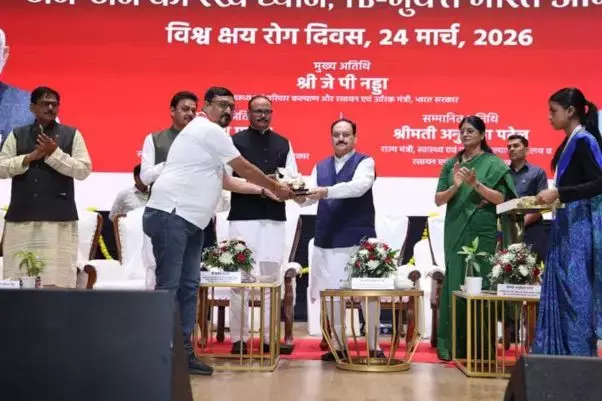
New Delhi | March 26, 2026
Union Minister for Health and Family Welfare Jagat Prakash Nadda reaffirmed India’s commitment to eliminating tuberculosis (TB) while addressing a national event marking World TB Day 2026 in Greater Noida. The minister emphasized that India is on a mission-mode approach to achieve a TB-free nation in alignment with global Sustainable Development Goals.
“Yes! We Can End TB” — Renewed Global Push
Observed every year on March 24, World TB Day highlights the urgency to eliminate one of the world’s deadliest infectious diseases. The 2026 theme, “Yes! We Can End TB!”, reflects renewed optimism and collective action, with India positioning itself as a global leader in TB eradication efforts.
India’s Progress Outpaces Global Averages
Highlighting major achievements, Nadda stated that India has recorded a 21% reduction in TB incidence and a 25% decline in TB mortality over the past decade—both higher than global averages. Treatment coverage has reached 92%, while undetected TB cases have significantly reduced from over 10 lakh annually to less than one lakh.
He credited this progress to a shift toward a people-centric model backed by innovation, strong political will, and community participation.
From Government Programme to People’s Movement
Referring to the vision of Prime Minister Narendra Modi, Nadda highlighted the role of Jan Bhagidari (people’s participation) in transforming TB elimination into a nationwide movement. The initiative now involves multiple ministries, elected representatives, and over 7.16 lakh “Ni-kshay Mitras” supporting patients.
Massive Screening Drive Detects Hidden Cases
Under the intensified TB Mukt Bharat Abhiyaan launched in December 2024, more than 20 crore vulnerable individuals have been screened, leading to the detection of 32.65 lakh TB cases.
Notably, 10.9 lakh cases were asymptomatic, marking a major breakthrough in identifying hidden infections that could otherwise spread undetected.
100-Day TB Mukt Bharat Campaign Launched
To accelerate progress, Nadda launched a focused 100-day TB elimination campaign covering 1.58 lakh villages and urban wards. The campaign will use localized micro-plans to target vulnerable populations such as urban poor, tribal communities, and migrants.
The initiative aims to bridge last-mile gaps in diagnosis and treatment while ensuring equitable healthcare access.
AI, Digital Tools Boost Early Detection
The government also launched the TB Mukt Bharat App, featuring “Khushi,” an AI-powered multilingual chatbot designed to guide users on symptoms, nearby diagnostic centers, and entitlements—even on basic smartphones.
Advanced technologies like portable X-rays, AI diagnostics, and molecular testing have been deployed nationwide to improve early detection and treatment outcomes.
Shorter Treatment for Drug-Resistant TB
A key medical advancement highlighted was the BPaLM regimen, which has reduced treatment duration for drug-resistant TB from 20 months to just 6 months, significantly improving patient compliance and recovery rates.
Funding and Research See Major Boost
Government funding for TB elimination has increased tenfold—from ₹640 crore in 2015-16 to ₹6,356 crore in 2025-26. Institutions like the Indian Council of Medical Research (ICMR) have played a crucial role, with innovations like the WHO-endorsed TrueNat diagnostic platform transforming TB detection.
Strengthening Last-Mile Healthcare Delivery
Minister of State for Health Anupriya Patel highlighted the expansion of healthcare infrastructure, including over 3,000 AI-enabled handheld X-ray devices, 9,800+ NAAT labs, and integration of TB services across 1.8 lakh Ayushman Arogya Mandirs.
She also noted that ₹4,590 crore has been disbursed to 1.39 crore TB patients under the Nikshay Poshan Yojana since 2018, ensuring nutritional and financial support.
States Play Key Role in Implementation
Uttar Pradesh Deputy Chief Minister Brajesh Pathak emphasized the importance of state-level execution, citing intensified case-finding and improved diagnostic systems in the state.
Community Support and Anti-Stigma Efforts
Nadda stressed that TB elimination requires both medical and social interventions. He reiterated that TB is preventable and curable, and early diagnosis is key to stopping transmission. Community awareness and stigma reduction remain critical components of the national strategy.
Nationwide Participation and Pledge
The event also saw the flagging off of Ni-kshay Vahan vehicles to enhance outreach in underserved areas. Health workers and volunteers were felicitated for their contributions, and a nationwide pledge was administered to reinforce commitment toward a TB-free India.
With a strong blend of policy, technology, and community engagement, India is accelerating its journey toward eliminating tuberculosis—setting a global benchmark in public health transformation.
