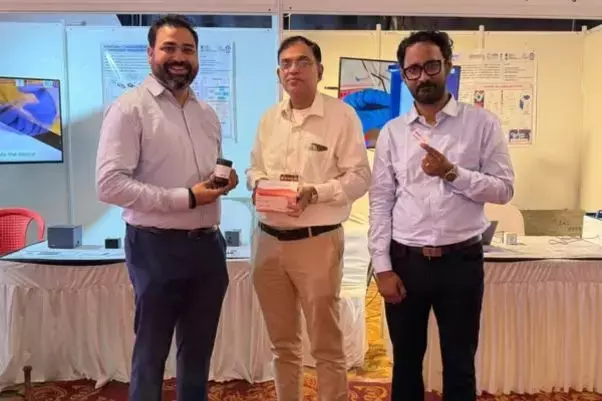
In a major boost to affordable healthcare, the Indian Council of Medical Research has recommended a new low-cost anaemia screening tool, ‘HemoQR’, developed at IIT Kharagpur. The innovation promises a quick and simple method to check haemoglobin levels without the need for bulky laboratory equipment.
Portable Device Uses Smartphone for Instant Results
Developed by SmartQR Technologies under the mentorship of IIT Kharagpur Director Suman Chakraborty, HemoQR is a portable kit that requires just a drop of blood from a finger prick. The sample is placed on a specially designed paper strip, which is then scanned using a smartphone camera to estimate haemoglobin levels within minutes.
This simple approach allows healthcare workers to perform anaemia screening even in remote and resource-limited settings.
Tested in Hospital Settings
The device has undergone testing at VMMC & Safdarjung Hospital, where it was found suitable for initial anaemia screening in both hospital environments and broader diagnostic processes. Experts believe such tools can significantly reduce dependence on traditional lab-based testing.
Boost to Public Health Initiatives
The recommendation is expected to strengthen government programmes like Anaemia Mukt Bharat and the National Health Mission, which focus on early detection and treatment of anaemia across the country.
Officials noted that the tool could be widely deployed in hospitals, primary health centres, and community health camps, enabling faster diagnosis and timely intervention.
Affordable Innovation for Mass Impact
Speaking on the development, Suman Chakraborty highlighted that HemoQR represents a step toward accessible healthcare solutions. The innovation demonstrates how technology can directly address widespread health challenges like anaemia, particularly in underserved areas.
Strengthening India’s Public Health Ecosystem
The development underscores IIT Kharagpur’s continued focus on practical, low-cost healthcare innovations with real-world applications. As India works to strengthen its public health infrastructure, such technologies are expected to play a crucial role in improving early diagnosis and expanding healthcare reach nationwide.