



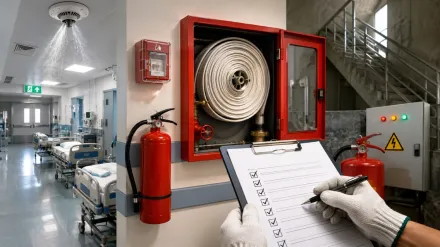
NEW DELHI, INDIA — The Union Ministry of Health and Family Welfare has issued a strict directive to all States and Union Territories, mandating a special drive to complete comprehensive fire safety audits across all public and private healthcare facilities by July 31, 2026. In a high-level correspondence, Union Health Secretary Punya Salila Srivastava emphasized that fire safety must become an institutionalized, non-negotiable component of daily hospital administration and patient safety protocols, shifting away from being handled as a superficial, one-time checkbox exercise.
Compulsory Integration with the IHIP Portal
The central directive formally introduces a strict accountability loop for healthcare operators nationwide.
- The Mandated Platform: All audited facilities must officially upload their comprehensive fire compliance logs onto the Ministry’s centralized Integrated Health Information Platform (IHIP).
- The Current Compliance Status: Official data indicates that 4,083 secondary-level public and private hospitals recorded verified fire safety audits on the IHIP portal during May 2026.
- Transition to Monthly Audits: To eliminate lax operational gaps, the Union Health Ministry has upgraded the regulatory framework, asking states to transition from annual checks to mandatory, month-on-month fire safety evaluations for all medical establishments, including local private nursing homes and medical colleges.
Laser Focus on High-Risk, Low-Mobility Zones
The administrative orders place a strong, protective emphasis on high-risk clinical environments. Regulatory oversight is being amplified specifically across Intensive Care Units (ICUs), Neonatal Intensive Care Units (NICUs), post-operative wards, nurseries, and critical care wings. Patients housed within these specific wards are highly immobile and often dependent on mechanical life support, making any potential smoke or fire outbreak exceptionally catastrophic.
This sweeping national intervention follows a alarming trigger event: a recent fire outbreak in the primary operation theatre of the Chigateri District Hospital in Davangere, Karnataka. While casualties were fortunately averted because elective surgeries had not yet commenced for the day, the near-miss exposed massive systemic vulnerabilities regarding active electrical loads and oxygen line vulnerabilities.
Enforcing evacuation drills and oxygen protocols
Under the newly disseminated National Guidelines on Fire and Life Safety in Healthcare Facilities, institutions are required to moving beyond basic Fire No-Objection Certificates (NOCs). Experts note that modern medical facilities face elevated risks due to heavy electrical equipment, air conditioning clusters, and continuous oxygen pipelines.
Consequently, states are instructed to ensure that hospitals regularly conduct live fire drills, workforce response training, thorough electrical load assessments, and strict emergency evacuation maneuvers. Particular focus must be given to developing staff capacity to safely transition ventilated or oxygen-dependent patients to secure secondary zones within a matter of minutes. The Health Secretary has urged state health heads to personally monitor the special drive’s execution to ensure healthcare spaces do not inadvertently transform into structural traps.


