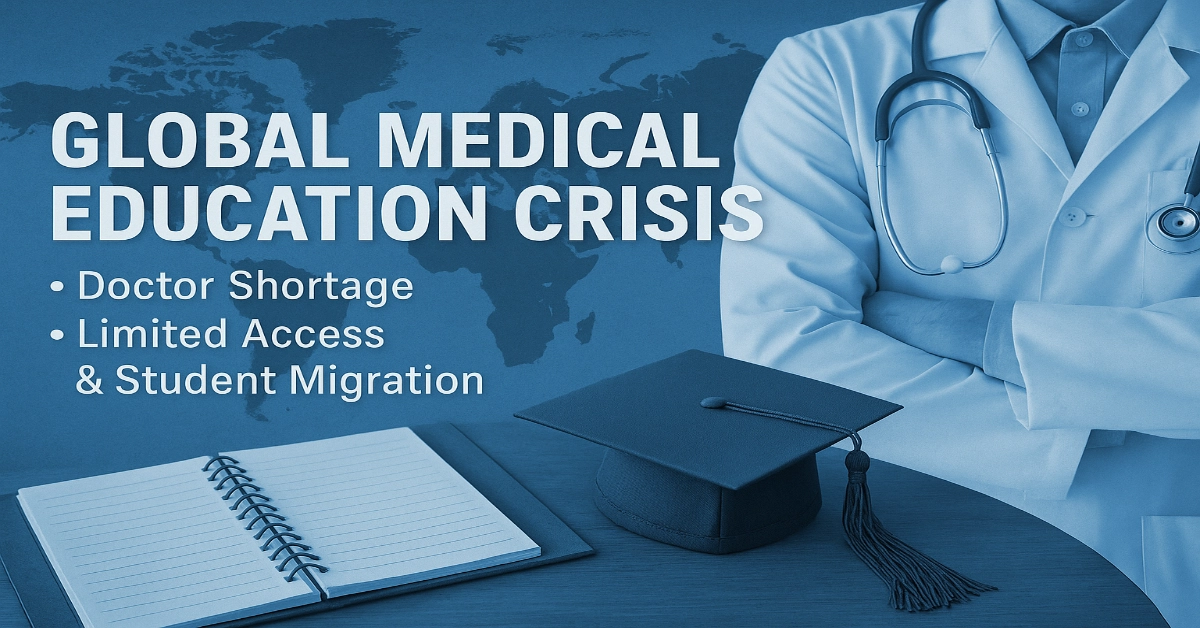
GENEVA — The World Trade Organization (WTO) has formally called on member nations to establish a unified, global framework for the mutual recognition of medical qualifications. This landmark directive aims to standardise medical credentialing globally, directly addressing the severe regulatory bottlenecks that currently restrict the cross-border mobility of healthcare professionals.
For decades, qualified doctors migrating between nations have faced redundant examinations, prolonged licensing delays, and bureaucratic hurdles. The WTO’s latest policy push seeks to eliminate these trade barriers under the General Agreement on Trade in Services (GATS), treating healthcare delivery not just as a localized public service, but as a critical global resource.
The Core Mandate: Eliminating Regulatory Fragmentation
The WTO’s proposed framework demands that national medical councils align their assessment criteria with a centralized, universally accepted standard. Under the current fragmented system, a physician certified by a premier institution in India or Asia must undergo entirely separate, rigorous validation processes—such as the USMLE in the United States or the PLAB/UKMLA in the United Kingdom—to practice abroad.
The WTO argues that while national sovereignty in healthcare safety must be respected, the current duplicative testing regimes represent an unnecessary barrier to the free trade of professional services. The organization proposes a tiered system of global accreditation. Under this model, medical schools that meet specific international benchmarks would receive automatic or highly expedited reciprocal recognition across all WTO member states.
Direct Implications for Indian Doctors and the NMC
This directive holds profound implications for India, which possesses one of the largest medical education systems in the world. For the thousands of Indian medical graduates (IMGs) who seek global fellowships, research opportunities, or clinical practice abroad, this framework could drastically simplify the transition. It would replace multi-year, expensive licensing pathways with a streamlined, document-verified onboarding process.
However, implementing these standards will require a significant overhaul of domestic regulatory oversight. The National Medical Commission (NMC) of India will face immediate pressure to upgrade and standardise the curricula, infrastructure benchmarks, and assessment methodologies of all domestic medical colleges. While top-tier Indian government and private institutions easily meet global metrics, a vast number of newly established medical colleges face challenges regarding faculty shortages and clinical exposure. To benefit from the WTO’s reciprocal agreements, the NMC must enforce stringent compliance to ensure that every Indian medical graduate meets the global baseline.
Addressing the Threat of ‘Brain Drain’
While the medical fraternity has largely welcomed the prospect of global mobility, the directive has raised immediate red flags among public health policymakers in developing economies. Critics argue that a seamless global standard will accelerate the “brain drain” from the Global South to the Global North.
India already battles a severe deficit in its doctor-to-patient ratio, particularly across rural and semi-urban districts. If Indian medical degrees gain frictionless, automatic recognition in high-income countries offering superior compensation and working conditions, the flight of medical talent could severely destabilise India’s public healthcare infrastructure. Economists warn that India risks subsidizing the healthcare systems of Western nations by bearing the cost of educating physicians who ultimately practice abroad.
Next Steps and Global Implementation
The WTO has clarified that this directive will not be enforced overnight. Instead, it serves as a formal call to action for the World Health Organization (WHO), the World Federation for Medical Education (WFME), and national regulatory bodies to form a joint transitional task force. Member nations are expected to submit their preliminary alignment strategies within the next eighteen months.
For Indian doctors, the development signals a future where clinical skills are valued as a borderless asset. However, for Indian healthcare administrators, it marks the beginning of a complex balancing act: upgrading domestic medical education to match global standards while creating competitive domestic environments to retain essential medical talent.