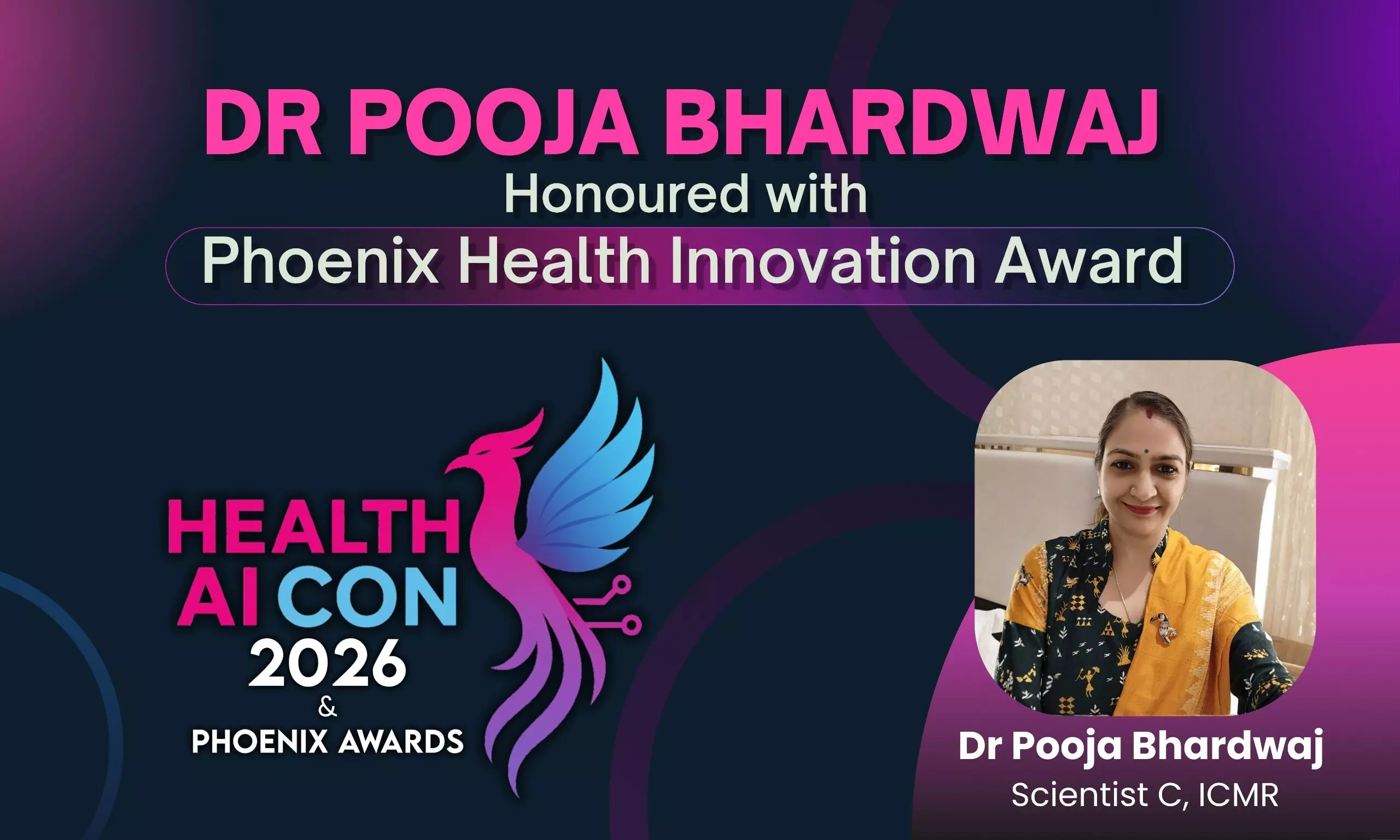
Award Recognises Breakthroughs in Rapid Infectious Disease Diagnostics
Dr Pooja Bhardwaj has been awarded the prestigious Phoenix Award at Health AI Con 2026 for her significant contributions to rapid infectious disease diagnostics and affordable healthcare innovation.
The award ceremony was held at Hotel Eros, New Delhi on May 17, 2026, and was presented by leading dignitaries from India’s healthcare ecosystem, including senior representatives from the National Medical Commission (NMC), NBEMS, ICMR, and the Dental Council of India.
Leadership Behind the Recognition
The award was presented by:
- Dr Abhijat Sheth, Chairperson, National Medical Commission (NMC) & President, NBEMS
- Dr Anil Kohli, Former President, Dental Council of India
- Dr Sanghamitra Pati, Additional Director General, ICMR
The recognition highlights India’s growing focus on AI-driven and molecular-level healthcare innovation.
Scientist at ICMR Driving Affordable Diagnostic Innovation
Dr Bhardwaj is currently serving as Scientist-C at ICMR–National Institute of Health Research, Gorakhpur (formerly Regional Medical Research Centre).
Her core research areas include:
- Molecular diagnostics
- Infectious disease research
- Point-of-care testing technologies
She is working to develop low-cost, field-deployable diagnostic systems for diseases such as:
- Dengue
- Chikungunya
- Scrub typhus
- Rickettsial infections
CRISPR-Based Diagnostic Revolution in Healthcare
A key highlight of her research is the development of CRISPR/Cas-based diagnostic platforms integrated with:
- Recombinase Polymerase Amplification (RPA)
- Microfluidics
- Portable detection systems
These systems can:
- Detect infections in 30–50 minutes
- Work without complex laboratory infrastructure
- Operate at constant temperatures
- Be deployed in rural and remote settings
Unlike conventional RT-PCR tests, these innovations aim to bring fast and affordable diagnostics closer to patients.
AI-Integrated Testing and Multiplex Detection Systems
Dr Bhardwaj’s innovations also include:
- AI-assisted diagnostic result interpretation
- Multiplex molecular testing platforms
- 3D-printed microfluidic devices
These tools enable simultaneous detection of multiple infections, improving accuracy in cases where symptoms overlap, such as dengue, malaria, and chikungunya.
Transforming Rural and Outbreak Healthcare
Her work focuses strongly on improving healthcare access in underserved regions.
Key benefits include:
- Faster diagnosis in primary health centres
- Reduced dependency on centralized labs
- Early treatment initiation
- Improved outbreak response capability
Experts believe such technologies could play a critical role in strengthening India’s public health preparedness system.
Key Insights from the Researcher (Interview Highlights)
On Motivation
Early diagnosis can significantly reduce complications in infectious diseases, especially where treatment already exists but is delayed due to testing limitations.
On CRISPR Technology
CRISPR systems detect specific viral genetic material and produce a visible signal, enabling quick identification of diseases like dengue and chikungunya.
On Speed of Diagnosis
Results can be delivered in 30–40 minutes, significantly faster than conventional laboratory methods.
On AI in Diagnostics
Artificial intelligence can improve accuracy, reduce errors, and support real-time outbreak surveillance.
On Future Healthcare Impact
Point-of-care molecular testing is expected to become more common in district hospitals and primary healthcare centres across India.
Significance of the Phoenix Award
The Phoenix Award recognises transformative innovation in healthcare. Dr Bhardwaj’s work highlights the rising importance of:
- Affordable diagnostics
- AI-integrated healthcare systems
- Rapid outbreak detection technologies
Her contributions represent a step forward in making advanced medical diagnostics accessible beyond urban hospitals.
Conclusion
Dr Pooja Bhardwaj’s recognition at Health AI Con 2026 underscores a major shift in India’s healthcare innovation landscape—towards faster, smarter, and more accessible diagnostic systems powered by CRISPR technology and artificial intelligence.