

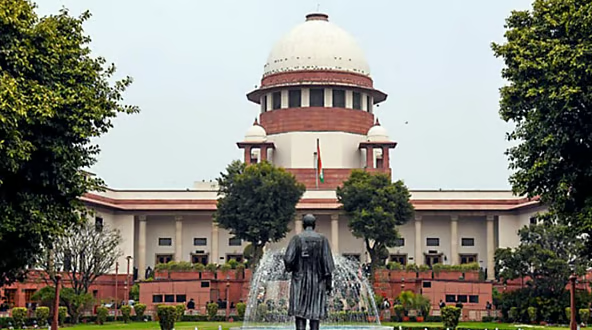
NEW DELHI — The Supreme Court of India has ruled that financial discrepancies, billing disputes, and service-related grievances against healthcare facilities are fundamentally civil or statutory in nature and cannot be prosecuted as criminal offences. Setting aside a previous order of the Calcutta High Court, the apex court quashed a criminal complaint filed against a prominent Kolkata-based hospital and its chairman. The bench observed that treating inadvertent invoicing errors as criminal acts constitutes an abuse of the legal process, drawing a clear line between systemic commercial transaction flaws and deliberate criminal intent.
The Origin of the Legal Dispute
The judicial intervention stemmed from a consumer grievance dating back to February 2021 at the Narayana Multispecialty Hospital located in Barasat, West Bengal. A patient was admitted to the healthcare facility for the surgical treatment of a fractured femur bone. Following a successful surgical procedure and subsequent medical discharge, the patient’s son paid a final consolidated bill amounting to ₹1,71,130.
However, upon auditing the transactional breakdown, the family discovered a billing discrepancy. The hospital had charged a sum of ₹2,500 for a High-Resolution Computed Tomography (HRCT) scan—a specialized diagnostic chest imaging test—that was never actually performed on the patient. When the family questioned the operational error, they alleged that the clinical administration responded with hostile behaviour and issued threats.
The complainant subsequently bypassed standard medical consumer forums and instituted a formal criminal case before a local Judicial Magistrate. The magistrate issued process against the healthcare facility under severe provisions of the Indian Penal Code, including Sections 406 (criminal breach of trust), 420 (cheating), and 120B (criminal conspiracy), alongside Section 34 of the West Bengal Clinical Establishments Act, 2017. The hospital administration appealed to the Calcutta High Court to have the case quashed, but the High Court remanded the matter back to the lower magistrate, hinting that a prima facie criminal case was visible.
The Supreme Court’s Analysis on Intent
A Division Bench comprising Justice Pamidighantam Sri Narasimha and Justice Alok Aradhe systematically dismantled the criminal charges. The bench clarified that for an offence of cheating under Section 420 to stand, a dishonest intention must exist from the very inception of the transaction. The evidence showed that as soon as the billing error was formally brought to light, the hospital acknowledged the mistake, generated a revised invoice, and repeatedly invited the complainant to collect a refund. The court noted that the billing discrepancy was a clear case of clerical inadvertence rather than a calculated, pre-planned attempt to defraud the patient.
Furthermore, the bench rejected the allegation of criminal breach of trust, stating that a standard medical bill settlement is a commercial transaction. It does not involve the “entrustment” of property for a fiduciary or trust-based purpose. Because the primary foundational offences of cheating and breach of trust were non-existent, the charge of criminal conspiracy was deemed unsustainable, as there was no evidence pointing to a prior meeting of minds to execute an illegal act.
Appropriate Channels for Patient Grievances
The apex court heavily emphasized that aggrieved patients possess robust legal pathways to resolve administrative or care-related issues without resorting to the criminal justice framework. The justices noted that allegations involving the non-supply or delayed delivery of medical records fall short of criminal thresholds. Instead, these issues constitute service deficiencies that are fully actionable under civil law.
The court explicitly highlighted that the West Bengal Clinical Establishment (Registration, Regulation & Transparency) Act, 2017, provides an independent regulatory mechanism to address patient care issues, overcharging, and structural deficiencies. Similarly, infractions regarding medical documentation can be taken before the Indian Medical Council under professional conduct regulations. The bench concluded that simply mentioning a statutory section in a complaint without demonstrating clear criminal methodology is legally impermissible. While the criminal case was thoroughly quashed, the court confirmed that the ruling would have no bearing on any separate civil compensation claims the family might choose to pursue through proper channels.

