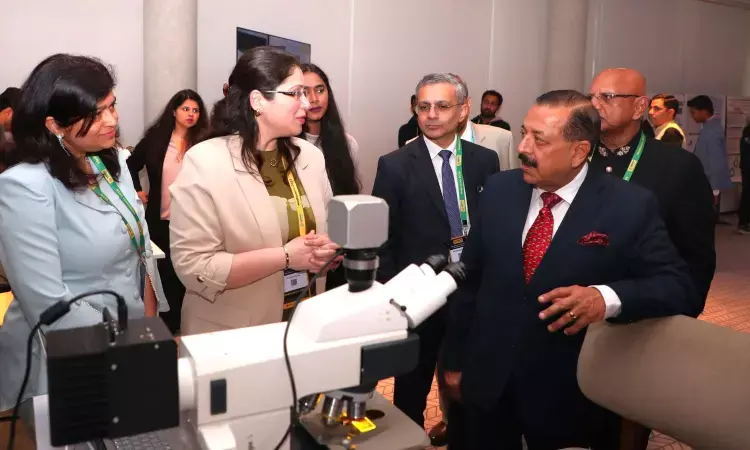
Minister Highlights Precision Medicine, Genomics and Policy Reforms at Medllumina 2026
New Delhi: Union Minister of State (Independent Charge) for Science & Technology and other key portfolios, Jitendra Singh, said that AI-developed tools are poised to eliminate subjectivity in medical diagnosis, enabling more precise and targeted treatment for patients. He was delivering the inaugural address at “Medllumina 2026: International Multi-Specialty Medical Conference.”
Explaining the impact of artificial intelligence in clinical practice, the Minister noted that while a pathologist examining a cancer biopsy slide with the naked eye might miss a minute yet critical cluster of abnormal cells, an AI-enabled system can pinpoint the exact location, thereby minimising human error. Similarly, AI tools analysing comprehensive patient datasets can flag subtle clinical findings that may otherwise be overlooked.
Dr Singh emphasised the importance of integrated medical dialogue, especially at a time when increasing super-specialisation often limits cross-disciplinary deliberation. He described multi-specialty academic platforms organised by diagnostic institutions as forward-looking initiatives, particularly as medicine increasingly integrates MedTech, engineering, and advanced data sciences.
Tracing the evolution of medical science, he referred to the transition from classical bedside clinical learning to technology-driven diagnostics such as ultrasound, CT scans, MRI and genomics. He observed that while earlier medical mastery relied heavily on extensive reading and experience, AI-enabled systems today complement and strengthen clinical judgement. AI-powered language tools, he added, are also helping bridge communication gaps in healthcare delivery.
Addressing India’s changing disease profile, the Minister said conditions once region-specific, such as diabetes in southern India or thyroid disorders in Himalayan regions, are now widespread nationwide due to lifestyle shifts and reduced rural–urban divides. Rising life expectancy has increased age-related diseases, while lifestyle disorders are affecting younger populations, making early and accurate diagnostics critical.
Dr Singh highlighted that India is entering a new era of genomics and gene therapy. Under the Department of Biotechnology, large-scale genome sequencing initiatives are underway, with a target of sequencing one million individuals. He also cited advancements in gene therapy for haemophilia and the development of India’s first indigenous antibiotic, Nafithromycin, as milestones reflecting the country’s growing life sciences capabilities.
Looking ahead, he said personalised medicine based on genetic profiling, environmental exposure, and lifestyle determinants will become standard practice. AI-driven analytics combined with genomic insights will enable physicians to tailor treatments to individual patients, replacing the conventional one-size-fits-all model.
Concluding his address, Dr Singh linked healthcare innovation to the broader vision of a “Viksit Bharat.” With over 70 percent of India’s population under 40, he stressed that strengthening diagnostics through AI, genomics, and quality standards is vital to ensuring accessible preventive and precision medicine, ultimately building a future-ready healthcare system for the nation.