

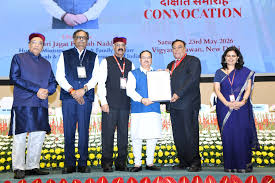
NEW DELHI — In a major development for the postgraduate medical workforce in India, the Union Minister for Health and Family Welfare, Shri Jagat Prakash Nadda, addressed the 23rd Convocation Ceremony of the National Board of Examinations in Medical Sciences (NBEMS).
The national event, held at Vigyan Bhawan, New Delhi on May 23, 2026, marked a milestone in advanced medical education, with postgraduate and postdoctoral qualifications formally conferred upon 26,396 specialist candidates across the country.
During the ceremony, the Union Health Minister introduced crucial policy directives, launched specialized academic courses, and detailed a fully funded infrastructure roadmap to expand medical seats by 2029.
23rd NBEMS Convocation Highlights:
┌─────────────────────────────────────────────────────────────┐
│ 1. 26,396 Specialist Doctors Conferred Postgraduate Degrees │
│ 2. 137 Academic Toppers Honored with Prestigious Gold Medals│
│ 3. 11 New Advanced Academic Courses Formally Launched │
│ 4. “One Nation One Subscription” (ONOS) Portal Rollout │
└─────────────────────────────────────────────────────────────┘
Massive Expansion of Postgraduate and Undergraduate Seats
Addressing the gathering of newly certified specialists, mentors, and healthcare leaders, Minister Nadda highlighted the central government’s commitment to expanding the country’s medical education footprint.
The minister reiterated the vision of Viksit Bharat 2047, stating that a healthy India is the foundation of a developed nation. To achieve this goal, he outlined a dedicated plan to add 75,000 more undergraduate (UG) and postgraduate (PG) medical seats by 2029.
Medical Seat Expansion Progress (Past Decade):
* Total Medical Colleges: Increased from 387 to 818
* Total Annual MBBS Seats: Reached nearly 1.28 Lakh
* Total Annual PG Specialties: Rose from 31,000 to nearly 85,000
* Target Added Seats (by 2029): 75,000 (23,000 already established)
The minister confirmed that 23,000 of these medical seats have already been established over the past two years. To build on this momentum, the government has sanctioned nearly ₹15,000 crore for the 2026–2029 period to systematically upgrade clinical education infrastructure and expand tertiary healthcare facilities.
The expansion also includes the growth of the All India Institute of Medical Sciences (AIIMS) network. India has grown from a single AIIMS facility at the end of the 20th century to 23 functional AIIMS institutions today, significantly improving regional access to high-quality tertiary care and advanced research.
Launch of 11 New Specialized Courses and ONOS Initiative
To ensure that medical qualifications keep pace with global developments, the Union Health Minister launched 11 new advanced academic courses designed by NBEMS. These courses aim to provide intensive specialization in emerging fields of patient care, equipping modern Indian doctors with the skills needed to manage complex clinical cases.
Technological & Academic Integration:
[Medical Infrastructure – Hardware] + [Skilled Specialists – Software] = Robust Healthcare
│
┌──────────────────────────────────┴──────────────────────────────────┐
▼ ▼
[11 New Advanced Courses] [One Nation One Subscription (ONOS)]
Provides deeper sub-specialty Delivers uniform access to world-class
training for complex patient care. journals and international clinical research.
In a major step toward promoting medical research, Minister Nadda also launched the One Nation One Subscription (ONOS) initiative for all NBEMS-affiliated institutions. Aligned with the national goal of building a self-reliant Atmanirbhar Bharat, ONOS acts as a central digital portal.
It provides students, educators, and working consultants across India with uniform, state-funded access to elite international scientific journals, premium medical literature, and global clinical databases. This initiative levels the academic playing field, ensuring that postgraduate trainees in smaller corporate or district hospitals have the same research resources as those in premier metropolitan teaching centers.
Shared Responsibility and Professional Quality Standards
During the ceremony, gold medals were awarded to 137 NBEMS toppers for outstanding academic performance during their residencies. The Health Minister noted that the DNB (Diplomate of National Board), DrNB (Doctorate of National Board), FNB (Fellow of National Board), and NBEMS Diploma qualifications have become recognized symbols of trust, quality, and clinical excellence.
Using a clear practical analogy, Minister Nadda described physical hospital infrastructure as the “hardware” of the country’s healthcare system, while qualified doctors serve as the vital “software”. He emphasized that medical education is both a distinct privilege and a deep social responsibility.
He concluded by urging the graduating specialists to bring empathy, dedication, and clinical innovation to their practices, playing an active role in strengthening healthcare delivery systems across India.
