Government Expands Financial Aid, Centres of Excellence and Pushes Indigenous Research for Rare Diseases
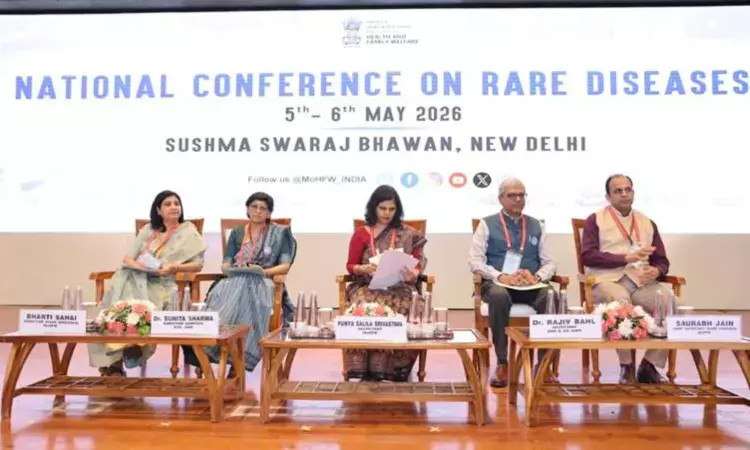
The Union Ministry of Health and Family Welfare inaugurated a two-day National Conference on Rare Diseases in New Delhi on May 5-6, 2026, marking a major step towards strengthening India’s healthcare response for patients suffering from rare diseases.
Addressing the inaugural session, Union Health Secretary Punya Salila Srivastava said the conference aims to understand stakeholder challenges, encourage innovation, and develop stronger strategies for the management of rare diseases in India.
She highlighted that the issue of rare diseases was first recognized in the National Health Policy 2017 and later institutionalized through the National Policy for Rare Diseases (NPRD) 2021, positioning India among nations with a comprehensive framework for rare disease management.
Centres of Excellence Expanded from 8 to 15
The Health Secretary stated that the policy is being implemented through Centres of Excellence (CoEs), comprising premier tertiary healthcare institutions across the country. The number of CoEs has increased from 8 to 15, including two centres in the North-East region, thereby strengthening clinical care and support infrastructure nationwide.
She further informed that financial assistance under the policy has now been enhanced up to ₹50 lakh per patient, significantly improving access to treatment for identified rare diseases.
Government Removes Customs Duty on Life-Saving Drugs
Acknowledging the high cost of therapies for rare diseases, the government has exempted several life-saving drugs from basic customs duty. Additional exemptions were also announced in the recent Union Budget to improve affordability and accessibility of treatment.
Srivastava invited stakeholders to recommend more drugs that could be considered for future exemptions.
Focus on Early Diagnosis and Genetic Counselling
The Union Health Secretary stressed the importance of early diagnosis, prevention, and genetic analysis in managing rare diseases effectively. She noted that awareness campaigns and capacity-building workshops are being conducted across states and urged stakeholders to identify more districts where such programmes can be expanded.
She also highlighted the progress under the Unique Methods for Management of Inherited Disorders (UMMID) initiative. Through NIDAN Kendras, genetic counselling services are being strengthened, while nearly 1,800 patients have already received treatment support under the rare disease policy.
ICMR Working on Affordable Indigenous Therapies
Speaking at the conference, Rajiv Bahl, Secretary of the Department of Health Research (DHR) and Director General of the Indian Council of Medical Research (ICMR), said India has witnessed remarkable progress in rare disease care over the past three decades.
He recalled that in the 1990s, diagnosis and treatment options for rare diseases were extremely limited, whereas today the government is able to provide financial assistance of up to ₹50 lakh per patient.
Dr. Bahl emphasized the need for India to develop its own context-specific model for diagnosis, treatment, and prevention rather than depending solely on Western frameworks.
He said ICMR is actively promoting indigenization of therapies and encouraging domestic production of affordable alternatives to expensive imported drugs through collaborations with industry partners and Centres of Excellence.
Repurposed Drugs and Gene Therapy Under Development
Dr. Bahl revealed that six repurposed drugs have already been identified for rare disease treatment, with clinical efforts underway to evaluate their effectiveness in improving patient outcomes and quality of life.
He also highlighted advancements in frontier technologies such as gene therapy, being pursued in collaboration with institutions including the Department of Biotechnology (DBT) and Council of Scientific and Industrial Research (CSIR).
Citing CAR-T cell therapy as an example, he said India is steadily moving closer to developing advanced therapies domestically.
Need for Stronger Health Systems and Awareness
Sunita Sharma, Director General of Health Services, stressed the importance of strengthening healthcare systems for early diagnosis and comprehensive management of rare diseases.
She underlined the need for expanding screening programmes, standardizing treatment protocols, and improving awareness among healthcare professionals and communities to ensure timely detection and referral of patients.
Technical Sessions to Focus on Genomics and Patient-Centric Care
During the two-day conference, experts and stakeholders will deliberate on advancements in genomic technologies, research collaborations, affordable treatment models, and patient-centric healthcare strategies.
The conference will also focus on improving coordination among stakeholders and expanding equitable access to quality healthcare services for rare disease patients across India.
Senior officials including Shri Saurabh Jain, Joint Secretary (Rare Disease), Ministry of Health and Family Welfare, and Smt. Bharti Sahai, Director, MoHFW, along with representatives from various Centres of Excellence, attended the event.