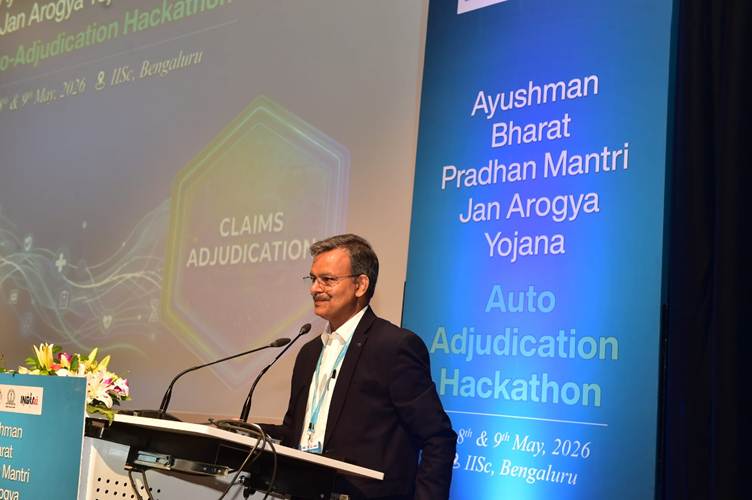
BENGALURU, May 11, 2026 — In a major step toward transforming the landscape of digital health in India, the National Health Authority (NHA) has successfully concluded the two-day AB PM-JAY Auto-Adjudication Hackathon Showcase 2026. Held at the prestigious Indian Institute of Science (IISc) in Bengaluru on May 8–9, the event marked the culmination of a nationwide effort to integrate advanced Artificial Intelligence (AI) and Machine Learning (ML) into the adjudication process for the world’s largest public health insurance scheme.
A New Benchmark for Digital Claims
The Ayushman Bharat Pradhan Mantri Jan Arogya Yojana (AB PM-JAY) currently processes an astounding 50,000 claims daily across more than 1,900 treatment packages. Historically, only 15% to 20% of these claims have been handled through automated systems, with the remainder requiring extensive manual review. The hackathon, organized in collaboration with the IndiaAI Mission and IISc, sought to address this by inviting startups, researchers, and students to develop “package-agnostic” solutions that reduce processing time and eliminate human error.
NHA CEO Dr. Sunil Kumar Barnwal noted during the event that while the scale of the scheme is unprecedented, the goal is to make the process completely transparent and highly efficient for both hospitals and the 55 crore beneficiaries.
Innovation Across Three Critical Fronts
The showcase featured winning solutions across three pivotal problem statements designed to safeguard the integrity of the health scheme:
- Clinical Document Classification: Team Nirnaya, led by Vinay Babu Ulli, took the top honors for an AI tool that can read diverse healthcare documents and automatically assess compliance with Standard Treatment Guidelines.
- Radiological Image Correlation: Team BiltIQ AI, led by Harish Kumar, won first place for their system capable of interpreting X-rays and MRI scans to correlate findings directly with insurance claim workflows.
- Fraud and Deepfake Detection: Team Sopa Claims emerged victorious for developing models that detect forged medical documents, tampered bills, and even AI-generated “ghost identities” used to siphon funds illegally.
Financial Incentives and Future Implementation
The winners were awarded cash prizes ranging from ₹2 lakh to ₹5 lakh, but the greater prize lies in potential long-term collaborations. The NHA has indicated that selected teams may be considered for implementation partnerships worth up to ₹50 lakhs to integrate their technologies into the official PM-JAY infrastructure.
The event also featured high-level panel discussions chaired by S. Krishnan, Secretary of the Ministry of Electronics and Information Technology (MeitY). Experts deliberated on the “Responsible AI” framework, emphasizing data privacy and the need for Small Language Models (SLMs) that can operate effectively in India’s multilingual and low-resource medical settings.
Through this initiative, India reaffirms its position as a global leader in utilizing Digital Public Infrastructure (DPI) to ensure that healthcare remains accessible, fair, and evidence-based for all citizens.